What are you actually paying for?
Price explains almost everything about an area, but it never tells you which part of it is worth anything to you. That is the question we are trying to answer.
If you could only know one single thing about an area before moving there, you would pick the price. No other measure comes close. Price is the market weighing up everything at once: the commute, the schools, the noise, the view, how safe it feels, how close the water is, the status of the address. Thousands of people have already looked at the area and voted with their money, and the sum of all those votes lands in one number per square metre.
That makes price by far the strongest explanatory factor we have. And that is also why it is nearly useless as a basis for a decision.
Price knows everything and tells you nothing
A lump sum cannot tell you why. It says the area is worth a lot, not what about it is worth a lot. Two houses can cost exactly the same and still carry completely different price tags underneath. One is paying for six minutes less commuting into town. The other is paying for a sea view and a street nobody drives down.
Pay for the first when what you really wanted was the second, and you have made a bad deal at exactly the right price.
The premium is always a sum of parts
No listing has a line item called premium. You pay one anyway. The gap between two neighbouring areas is rarely random. It is made of concrete things the market has already priced:
- Travel time to a workplace you may not have
- A school catchment area that matters for ten years of your life, not forty
- Night buses and late trains for an evening life you may not live
- A view and closeness to water, which you either notice every day or never think about
- The status of the address, which other people care about more than you do
The market gives no discount for what you never plan to use. The price contains all of it, whether you pick it up or not.
This is what we are trying to do
MapAndMove exists to pull that lump sum apart. We stack data on top of the map: noise, travel time, swimming spots, nature, air quality, school results, crime statistics, broadband, sun and shade, how many hours of daylight you actually get in January. Every layer is one of the things buried inside the price.
The goal is easy to state and hard to do: we want to be able to say that a square metre costs more here than in the neighbouring area, and that most of the difference sits in the commute. Or in the water. Or in the schools. Once you can see what the premium is made of, you can decide for the first time whether that particular premium is worth anything to you.
Putting the money where it lands
Someone who commutes by car does not care about the distance to the metro, yet pays for it anyway if they search where everyone else searches. Someone who works from home often pays a hefty sum to be near a workplace that no longer exists. Someone who loves swimming, on the other hand, will happily pay extra for five minutes to a jetty, and that premium earns its keep every summer for twenty years.
Same money. Completely different outcomes. The difference is not how much you pay, but what you happen to be paying for.
That is why we think a map is the right tool. Not because it hands you an answer, but because it lets you compare like for like. Strip away what you do not care about, add what you actually use, and see where your money stretches furthest.
What this is not
This is not a valuation and it is not investment advice. We cannot tell you what a house is worth and we are not going to try. Nor can we decide what you should like. Some things never show up in data: what the neighbours are like, whether the square feels alive on a Tuesday evening, whether the light in the kitchen is right.
What we can do is show what separates one area from another, so you do not pay a premium blindly. The rest is your decision, and it should be.
Getting started
Open the map, switch on the layers that matter to your everyday life and switch off the rest. Compare two areas you are considering and look at what actually separates them. Save what you like and come back to it when you have the energy.
The goal is not to find the most expensive area you can afford. The goal is to find the area where every krona you spend goes towards something you will use.
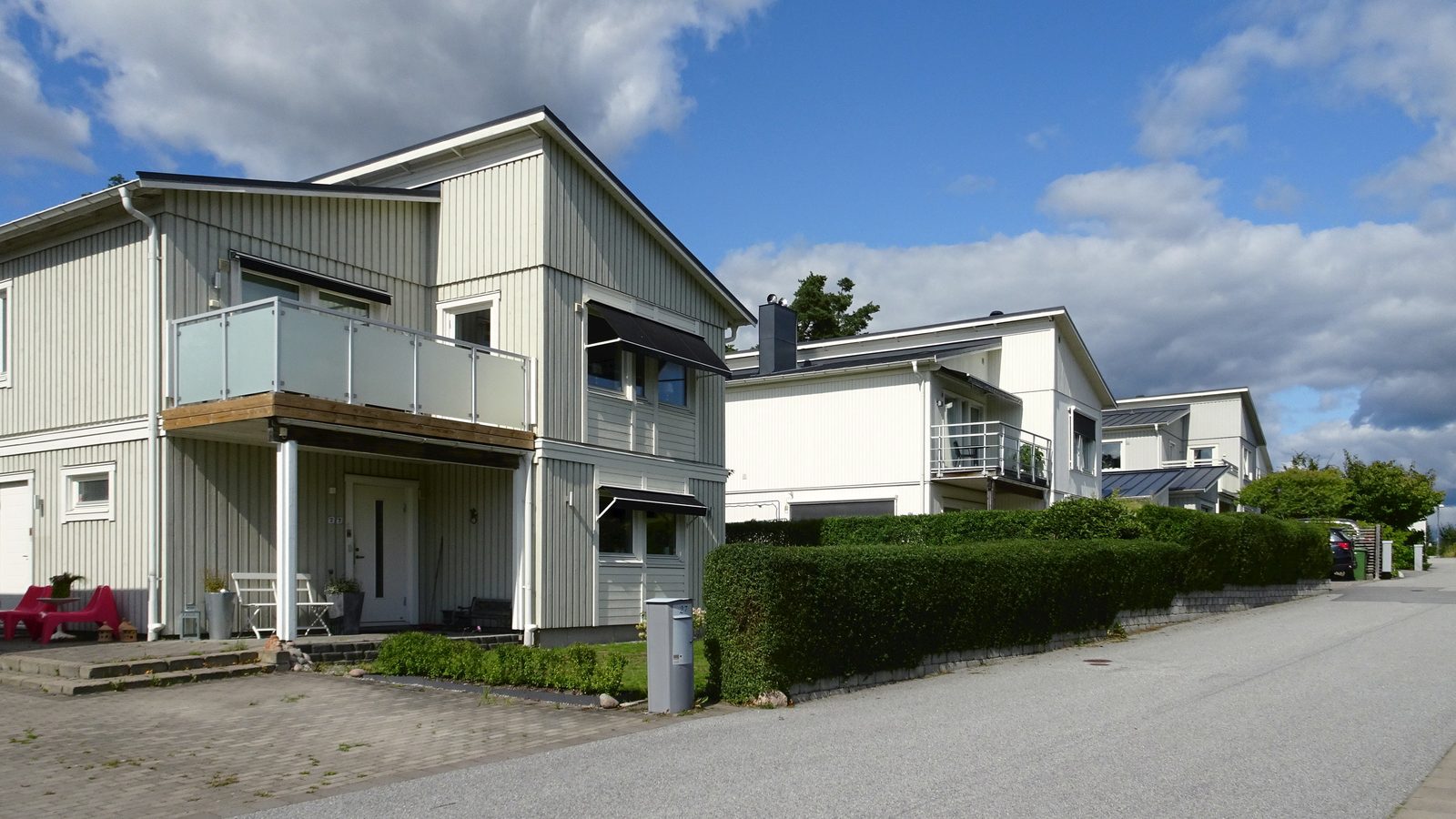
Photo: Holger Ellgaard, housing area in Gåshaga, Lidingö, 2021. Licensed under CC BY-SA 4.0. The image has been cropped and downscaled.
One municipality at a time, straight to your inbox.
A letter every other week. No ads, no reselling.