The data centres are coming. What do they do to the places they end up in?
Electricity, costs, water, nature and noise: what research and the authorities say about the new data centres in Sweden, and where the knowledge runs out.
Data centres are being built in Sweden at a pace without precedent. Strängnäs, Borlänge, Skellefteå, Horndal, Hässleholm, Timrå: in a short time one municipality after another has learned that facilities of hundreds of megawatts are on their way. We have added the planned projects to the map, and while reading up to do so, one question became unavoidable. What do these buildings do to the places where they end up?
This is what the research and the authorities actually say, and where the knowledge runs out.
What does a data centre do?
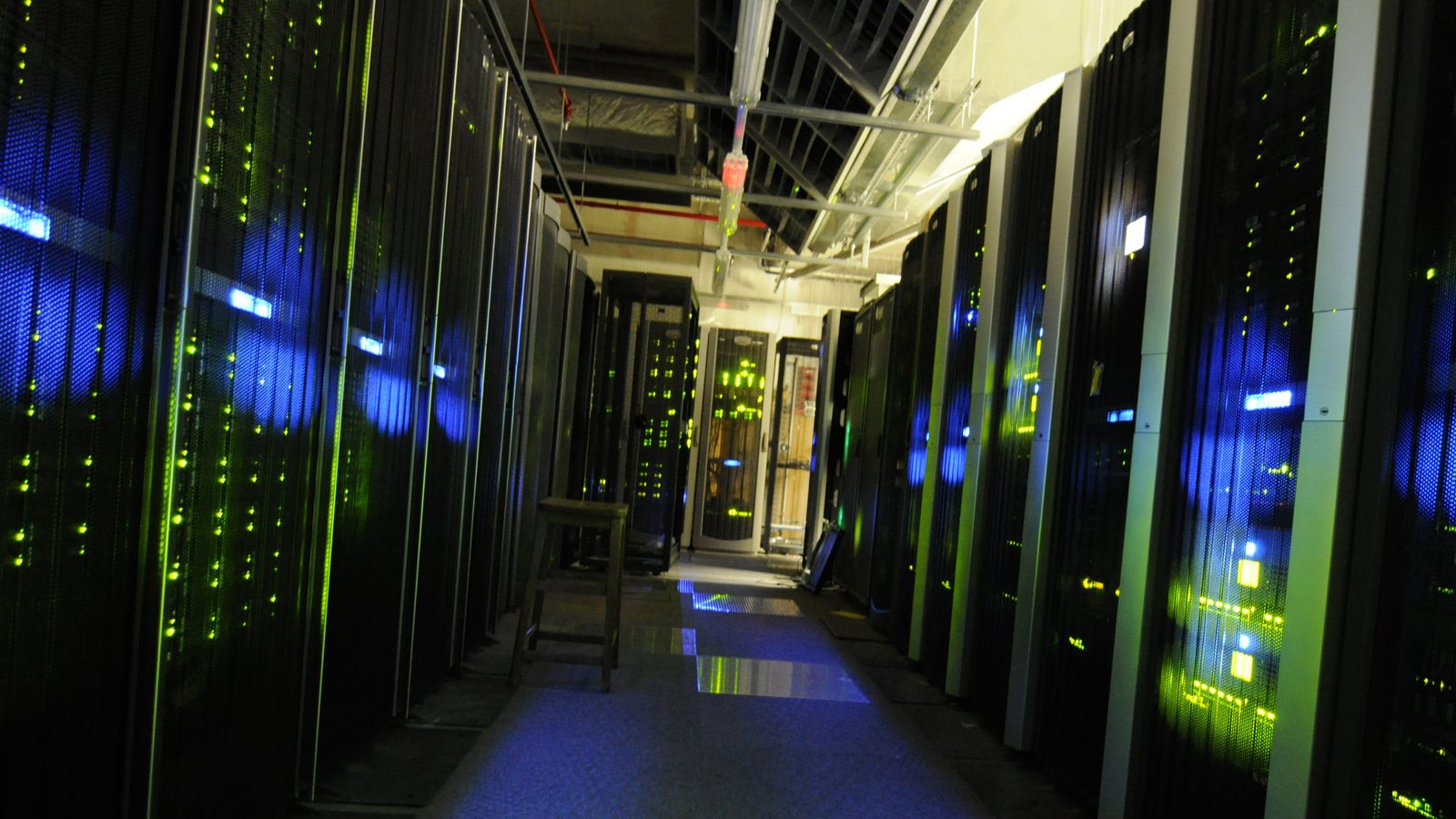
At heart, a data centre is a building full of computers that are never switched off, plus everything needed to keep them running: power, cooling and backup power. What they compute varies.
- Cloud services, meaning Microsoft, Amazon and Google, who rent out computing power and storage to companies and public agencies.
- Colocation, where companies rent space and power for their own servers.
- Network nodes, where operators interconnect their networks. They are small but important.
- AI and HPC, meaning training and running AI models and heavy computation. This is where almost all the growth is. The industry itself says 75 to 80 percent of it is driven by AI.
- Crypto mining, which was big in northern Sweden a few years ago but has shrunk. It accounted for 1 to 1.5 TWh in 2022 and was expected to fall below 1 TWh.
Electricity: the big question
Nobody knows exactly how much electricity Swedish data centres use today. RISE, commissioned by the Swedish Energy Agency, estimated 2.8 to 3.2 TWh for 2022. A peer reviewed study in the journal Heliyon (Jerléus et al. 2024) counted from the bottom up, facility by facility, and arrived at roughly double that, 6.7 TWh. That two serious estimates differ by a factor of two says something about how little has been reported.
What is certain is the direction. In its short term market analysis from March 2026, Svenska kraftnät, the national grid operator, expects data centre consumption to rise from about 3 TWh in 2026 to about 9 TWh in 2030. Data centres are the only category where the agency has raised its assumption.
What really stands out is the power, meaning how much electricity must be delivered at the same time. According to Svenska kraftnät, data centres totalling around 7,000 to 7,500 MW want to connect to the transmission grid. On a cold January day, all of Sweden uses roughly 24,000 to 26,000 MW. Almost all of it is sought in price area 3, central Sweden, where applications for large data centres rose from about 1,300 MW in 2024 to almost 6,700 MW in 2025.
Not all of it will be built. The same project can appear in several applications, and some have already been paused. Vantage's plans in Tierp are on hold while waiting for power. But even a fraction of the queue is a lot.
What does it mean for you? For people living near a large project, it is less about the electricity bill and more about the grid. When a data centre takes a large share of the spare capacity in an area, it can become harder and more expensive for others to connect: new housing, charging stations, industry. Svenska kraftnät has said plainly that 750 MW in Strängnäs is far too much for the local grid as it stands today. How much electricity prices are affected, however, has not been calculated for Sweden. American studies point in different directions.
Costs: who pays?
In 2017 data centres were given a sharply reduced energy tax on electricity, to attract investment and jobs. The Swedish National Audit Office reviewed the support in 2022: it had cost the state 1.3 billion kronor over five years, three companies had received more than half of the money, and nobody had calculated what it delivered in jobs. The reduction was abolished on 1 July 2023, and today data centres pay the same energy tax as other service companies.
The grid is where the cost is still shared. Whoever connects pays for the parts built specifically for them, but according to Svenska kraftnät reinforcements in the meshed transmission grid are largely shared by all grid customers through the tariff, and reach households through the regional and local networks. In October 2026 Svenska kraftnät's queue held over 7,300 MW of data centres, and the agency plans investments of 180 billion kronor up to 2035. Svenska kraftnät's large new lines, such as Nordsyd at over 100 billion kronor, are not built for data centres alone, but data centres are part of the reason they are needed. We have not found anyone who has calculated how much of households' grid fees is down to data centres.
There are fewer jobs than one might think. EcoDataCenter expects 200 to 300 permanent jobs at its campus in Borlänge, roughly one job per megawatt. The paper mill that stood on the same site had about three times as many per megawatt. Meta's facility in Luleå created just over 900 jobs during construction and just over 200 in operation. The construction phase is large, operations small.
The municipality does not get as much tax as one might expect either. Property tax on industrial property goes to the state, not the municipality. What the municipality earns is mainly the land sale and the income tax from employees who live there. The land deals are no giveaways: Microsoft paid 145 million kronor for 66 hectares in Gävle and 124 million in Sandviken, and EcoDataCenter has agreed to buy land for 200 million in Borlänge. What the municipalities themselves spend on roads, water and sewers up to the sites, on the other hand, we have not found compiled anywhere.
There is one bright spot: waste heat. The servers get warm, and that heat can warm homes through the district heating network. Stockholm already recovers heat from data centres, and the goal is for a tenth of the city's heat to come from them by 2035, compared with just over one percent today. The problem is that the heat is lukewarm, around 35 degrees, and cannot be transported far. A data centre in the forest far from the nearest town has nobody to heat.
Water: less of a problem here than in the US
In the US, water is a hot issue. A Cornell study in Nature Sustainability (2025) estimates that AI servers there could draw close to a billion cubic metres of water a year by 2030, mainly for evaporative cooling in hot and dry states.
Sweden is different. It is cold enough that outside air can cool the servers 93 to 98 percent of the year, so evaporative cooling is rarely needed. Amazon's facilities in the Mälaren region report 0.02 litres of water per kilowatt hour, a fraction of the EU reference level of 0.4. Since 1 July 2025 all data centres over 500 kW must report their water use, so in a year or so there will be real figures.
Water is therefore probably not a national constraint. Locally, in dry summers in south eastern Sweden, it may be another matter.
Nature: land, power lines and diesel
A large data centre campus takes a lot of land. Vantage planned around 400 hectares in Tierp. Google has bought just over 100 hectares of forest in Horndal. Brookfield's campus in Strängnäs covers about 35 hectares. On top of that come the power lines leading there, with their corridors through the forest.
There are good examples too. EcoDataCenter in Borlänge is building on a closed paper mill, EdgeConneX in Skellefteå on land intended for Northvolt. There, industrial land is reused instead of new forest being cleared.
A lesser known part is backup power. Every large data centre has diesel generators in case the power fails. Amazon's permit in Katrineholm covers around 100 generators totalling up to 660 MW. They are to run well under 500 hours a year, mostly for testing, but they are assessed under the Environmental Code precisely because the emissions are not negligible. More and more are switching to renewable diesel (HVO).
There is, however, almost no research on how data centres affect biodiversity. The knowledge sits in each project's environmental impact assessment and nature survey, not in any collected study. If you want to know what is on the land where a data centre is planned, the municipality's detailed development plan is the right place to look.
Sound: the low hum
This is the issue neighbours raise most often, and where knowledge is thinnest. Chillers, fans and generators give off a lot of low frequency sound, below 200 Hz. Such sound passes easily through walls and windows, and it shows up poorly in ordinary noise measurements in dBA, which are weighted towards how the ear perceives the midrange.
In Sweden, the Swedish Environmental Protection Agency's guideline values for industrial noise apply: 50 dBA during the day, 45 in the evening and 40 at night outdoors at homes, five decibels lower if the sound has audible tones. The Public Health Agency of Sweden also has guideline values for low frequency noise indoors, measured per frequency band from 31.5 Hz, precisely because dBA misses it. For infrasound, below 20 Hz, Sweden has no guideline value at all.
The audible hum is a real problem. Constant, tonal low frequency noise is experienced as more annoying than other noise at the same level. A review of the studies (Baliatsas et al. 2016) finds links to annoyance, poorer sleep, difficulty concentrating and headaches, and roughly one in ten of those exposed become highly annoyed. Support for chronic disease, on the other hand, is very weak.
Inaudible infrasound has shown no effects in controlled trials. It is often said that sound below the threshold of hearing makes people ill. Animal studies show that the inner ear does respond to infrasound that is not perceived, so the idea is not absurd. But when it has been tested blind on people, nothing happened. In an Australian study from 2023, noise sensitive people slept for 72 hours with infrasound at around 90 dB without sleeping worse than with a sham source; traffic noise, by contrast, did worsen sleep. In a Finnish study from 2020, nobody could even tell when the infrasound was on. And in a New Zealand experiment, people who had first watched worrying material about infrasound got symptoms even when exposed to fake infrasound. Expectation goes a long way.
Almost all of that research concerns wind power, not data centres. At data centres there are hardly any measurements at all. The only one we have found, from a facility in Georgia in 2026 and commissioned by the developer itself, showed infrasound far below the threshold of hearing, the cooling barely audible and the backup generators clearly audible. The real risk from a data centre is therefore an audible hum that disturbs sleep, not invisible infrasound.
The best documented example comes from Loudoun County in Virginia, the world's densest data centre area. Neighbours there have filed over 40 complaints about a constant hum, and the county itself writes that dBA measurements generally do not capture low frequency noise.
We have not found any documented neighbour complaints about data centres in Sweden. That may mean the problem is small here, or that facilities have so far been located far from homes. As the new ones come closer to towns, as in Strängnäs and Akalla, it is worth keeping an eye on.
The US: what has happened, and what is only claimed
The US is a few years ahead of Sweden, and that is where most of the horror stories come from. Some of them hold up, others do not. This is how it looks when you go to the sources.
What is documented:
- Electricity bills in the eastern US. In PJM, the large grid from Chicago to Washington, the market's own monitor judged that data centres were behind roughly two thirds of the price increase in the capacity auction for 2025/26. Maryland's consumer advocate estimates that data centres account for 9.3 of 12.5 billion dollars in added costs, and households have noticed it on their bills. In Georgia, the largest utility has raised prices six times in three years, and the regulator has approved a buildout of around 10,000 MW for data centres that, according to its own staff, customers will pay 50 to 60 billion dollars for over time. The regulator promises that households will not pay for the data centres; consumer groups do not believe it. Outside PJM the picture is more mixed: in several states with strong growth, electricity prices have actually fallen.
- The diesel generators. When the power fails, the backup generators run, and it has happened for real. Microsoft's data centre in Leesburg, Virginia, ran 62 diesel generators for seven days after an outage in 2025 and went far beyond its permit: almost twice the annual diesel cap and too much nitrogen oxides, hydrocarbons and particulates. The state environmental agency proposes a 2.5 million dollar penalty, the largest against a data centre so far, and Microsoft has signed. In July 2026 the gas turbines powering Vantage's data centre in Sterling failed, and dozens of diesel generators ran for almost a full day, on a day when the air was already unhealthy from wildfire smoke. A neighbour measured 60 dB at his property line against the county's night limit of 55 and fled his home. The agency said it could not stop the operation, because the permit allows running in an emergency. In New Jersey a data centre in Vineland was fined 1.07 million dollars in 2026 for 62 generators run entirely without permits.
- Gas turbines without permits. Elon Musk's AI company xAI ran up to 35 gas turbines without permits at its data centre in Memphis, in an area that already has poor air. The county later permitted 15 of them. At its next site, in Southaven, Mississippi, the NAACP sued the company in 2026 over around 27 turbines run before the permit came.
- Spills and floods. A data centre in New Jersey leaked around 5,000 gallons of diesel into a creek in 2026. Google's construction site in Virginia was cited by the state environmental agency for sediment that silted up over two kilometres of stream bed and filled wetlands without a permit. In Mason County, West Virginia, a sediment pond on a data centre site gave way, and the neighbourhood below was flooded twice in 2026. The state halted parts of the work, and the company is paying for the damage and offering to buy the homes.
- Wastewater. In Cheyenne, Wyoming, a contractor on Meta's site in 2026 discharged water carrying a rare bacterium that knocked out the city's reclaimed irrigation water system for months. The city has cut off Meta's discharges for good. Drinking water was not affected.
- Water in dry regions. Tucson in Arizona said no to a large project in 2025 out of concern for water, and the contractor had already trucked city water to the site without permission. In Fayette County, Georgia, it emerged that the QTS data centre had drawn over 29 million gallons through a meter the county did not know about; the company paid afterwards but was not fined. In Texas, according to a research report, data centres' water demand could grow up to sixfold by 2030, without being included in the state water plan. The city of The Dalles in Oregon fought for over a year to keep Google's water use secret.
- Everyone pays for the grid. The Union of Concerned Scientists went through 130 projects in seven states where data centres were connected directly to the transmission grid in 2024. In over 95 percent of them the entire connection cost was passed on to all of the utility's customers, around 4.3 billion dollars in total, 1.9 billion of it in Virginia. Researchers at Harvard describe how it happens: utilities sign special contracts with data centres that are reviewed with little transparency, and costs are reallocated in several steps until they land on households. Ohio shows it can be done differently: since 2025 large data centres there must pay for at least 85 percent of the capacity they have reserved for up to twelve years, even if they use less. Google, Amazon, Microsoft and Meta opposed the rule.
- The tax breaks. Almost every state lures data centres with tax breaks, and the bill has turned out far larger than forecast. Virginia gave up over 1.9 billion dollars in sales tax in 2025, more than half of all the state's business incentives, and according to its own audit agency got back 48 cents per dollar. Ohio lost over 1.5 billion dollars in 2025, about eleven times the forecast, and has paused new exemptions. A review in Georgia concluded that the incentive loses 91 percent. In Oregon schools lost 275 million dollars to property tax abatements in 2024, mostly to new data centres, and 14 states do not report at all what the incentives cost. The jobs meant to justify them are few: in Virginia around 50 permanent jobs per facility, half of them contractors. Many of the figures were compiled by the group Good Jobs First, which wants the incentives abolished, and the industry points out that data centres still pay billions in state and local taxes. The cost is documented; the net effect is disputed.
- Land. In Virginia a court voided plans for a data centre zone of around 850 hectares next to a Civil War battlefield.
- Noise. At least six class actions over noise are under way against data centres in the US. At Microsoft's large AI facility in Mount Pleasant, Wisconsin, neighbours have sued over a low frequency hum, and Microsoft has itself acknowledged the hum and promised to dampen it.
Almost all of these cases came to light because neighbours, local papers or environmental groups dug, not because the companies told anyone. That is partly down to the rules. In Virginia, 189 of 197 air permits for data centres are so called minor permits, which require no public consultation. The emergency exemption lets backup power run for as long as the grid is down. And neither Virginia nor the federal Environmental Protection Agency requires data centre wastewater to be tested for PFAS.
What is alleged:
- Poisoned wells. Neighbours of Meta's data centre in Newton County, Georgia, got cloudy water in their private wells after construction, and families sued Meta in autumn 2026. Meta points to an external well study that found no connection. Nothing has been decided. We have not found any case where an authority has established that a data centre contaminated a town's drinking water; Cheyenne is the closest, and there it was irrigation water.
- Dirtier air in Memphis. Satellite data analysed by researchers at the University of Tennessee show that nitrogen dioxide levels have risen around xAI's facility, but the increase comes both from the data centre and from a neighbouring power plant. Ground measurements are almost entirely missing.
- Illness from noise. Residents near a bitcoin mine in Granbury, Texas, describe dizziness and tinnitus. These are their accounts, not medical findings, and the mine's site manager was acquitted in the noise case.
What is not true: that the grid cuts off households before data centres. It is the other way round. A Texas law from 2025 requires large data centres to be disconnectable first in a crisis, and during an emergency in 2026 the federal Department of Energy ordered data centres to switch to their own generators so that homes and hospitals kept their power. What is true is that data centres can make the grid unstable for everyone: in Virginia in 2024, 1,500 MW of data centres dropped off the grid at once, and after several such events the North American grid reliability regulator issued its highest level of alert in May 2026.
Roughly the same questions exist in Sweden, but the conditions differ. It is colder here, water is not scarce, backup power is assessed by environmental courts and data centres no longer get a tax discount. The grid and electricity prices are where Sweden most resembles the US.
What we know and what we don't
We know that data centres are growing fast, that they want a lot of power in a short time and that almost all the demand is in central Sweden. We know that jobs are few relative to the investment and that water is less of a problem here than elsewhere.
We don't know how much electricity they use today, with a factor of two in uncertainty. We don't know how electricity prices are affected, how much waste heat is actually put to use or how nature is affected overall. No Swedish noise studies exist.
Most of the knowledge that does exist is local: in detailed development plans, environmental permits and consultation documents at the municipalities. If a data centre is planned where you live, or where you are thinking of moving, that is where you will find the answers.
See them on the map
All the data centres we know of, both existing and planned, are available as a layer on the map. Planned facilities are shown fainter, and if you click one you see the operator, planned power in megawatts and a link to the source. The power is the figure given by the operator or the municipality, often as "up to", and never the backup power permit figure. Combine it with the layers for price areas and the grid to see why they end up where they do.
Sources
- Swedish Energy Agency and RISE, Energy use in data centres and digital systems (2023, in Swedish)
- Jerléus et al., Heliyon 2024, on the electricity, water and siting of Swedish data centres
- Svenska kraftnät, Short term market analysis 2025 (March 2026, in Swedish)
- WSP, Data centres grow without a national compass (June 2026, in Swedish)
- EFN, The AI boom's 100 billion stuck in the grid (September 2026, in Swedish)
- Confederation of Swedish Enterprise, report on data centres (April 2026, in Swedish)
- Swedish Tax Agency, abolished tax reduction for data centres (in Swedish)
- IEA, Energy and AI (2025)
- Cornell, the study in Nature Sustainability (2025)
- AWS, fact sheet for Sweden
- Swedish Energy Agency, reporting of data centre energy performance (in Swedish)
- Land and Environment Court, ruling on backup power in Katrineholm (2022, in Swedish)
- Swedish Environmental Protection Agency, Guideline values for industrial noise (report 6538, in Swedish)
- Public Health Agency of Sweden, FoHMFS 2014:13 on indoor noise (in Swedish)
- Loudoun County, Data Centers: Noise and Air Quality
- Baliatsas et al., review of health effects of low frequency noise (2016)
- Crichton et al., Can expectations produce symptoms from infrasound? (Health Psychology 2014)
- VTT, study of health effects of infrasound from wind turbines (2020)
- Marshall et al., infrasound and sleep over 72 hours (Environmental Health Perspectives 2023)
- Salt and Hullar, the inner ear's response to infrasound (2010)
- Swedish Environmental Protection Agency, infrasound and low frequency sound from wind turbines (2011, in Swedish)
- IEEFA, data centres and PJM capacity prices
- Maryland Office of People's Counsel, Rising Electricity Rates
- JLARC, Data Centers in Virginia (2024)
- LBNL via APPA, electricity prices in states with strong load growth
- TechCrunch, xAI and the gas turbines in Memphis (2025)
- The Sun, the diesel spill in Secaucus (September 2026)
- 12 On Your Side, Google's site in Chesterfield (October 2026)
- AZFamily, Tucson rejects Project Blue (2025)
- HARC via Energy Capital, data centre water demand in Texas
- KSAT/AP, The Dalles and Google's water use (2022)
- Stateline, tax breaks for data centres (April 2026)
- FOX 5, Prince William Digital Gateway
- AJC, families sue Meta over well water (September 2026)
- TIME, the bitcoin mine in Granbury (2024)
- Utility Dive, Texas law on disconnecting data centres (2025)
- U.S. Department of Energy, 202(c) order for PJM (2026)
- WUSA9 via Yahoo, the diesel generators in Sterling (July 2026)
- Northern Virginia Magazine, the neighbour in Sterling and the noise (July 2026)
- When In Your State, the penalty against Microsoft in Leesburg (2026)
- NJDEP, the fine in Vineland (2026)
- WLBT, NAACP sues xAI in Southaven (April 2026)
- VPM, Project Peanut and the wetlands (October 2026)
- WSAZ, the flooding in Mason County (July 2026)
- Tom's Hardware, Cheyenne and the reclaimed water (2026)
- Fortune, QTS, Tucson and Meta's well study (May 2026)
- WPR, Microsoft sued over noise in Mount Pleasant (2026)
- NBC News, class actions over noise (2026)
- CBS News Atlanta, Georgia Power's buildout (2025)
- TechCrunch, air quality around xAI in Memphis (2025)
- Quartz, NERC's alert (May 2026)
- Virginia Mercury, data centre wastewater and PFAS (June 2026)
- Riksrevisionen via skr. 2022/23:36, state measures for data centres (RiR 2022:18) (2022, in Swedish)
- Riksdagen, committee report 2022/23:NU11 (2023, in Swedish)
- Svenska kraftnät, guidance on cost allocation and connection fees (April 2026, in Swedish)
- Energinyheter, Svenska kraftnät's grid development plan (December 2025, in Swedish)
- DataCenterSweden, data centres in Svenska kraftnät's queue (October 2026, in Swedish)
- Gävle kommun, Microsoft's sites in Gävle and Sandviken (in Swedish)
- Borlänge kommun, the land deal with EcoDataCenter (2025, in Swedish)
- Union of Concerned Scientists, connection costs in PJM (2025)
- Martin och Peskoe, Harvard, how you subsidize big tech with your electricity bill (2025)
- POWER, AEP Ohio's data centre tariff (2025)
- WRIC, JLARC on Virginia's sales tax exemption (2026)
- GMU STEP, jobs in Virginia's data centres (September 2026)
- The Register, Ohio pauses the tax breaks (June 2026)
- Good Jobs First, what the tax breaks cost the states (2026)
- Oregon Capital Chronicle, schools and property tax abatements (2025)
- Stockholm, heat recovery from data centres
One municipality at a time, straight to your inbox.
A letter every other week. No ads, no reselling.